Updated June 2026 — Estimated time to competency: 3–6 weeks of focused daily practice — Difficulty: Beginner — Category: How-To & Educational
What You'll Learn
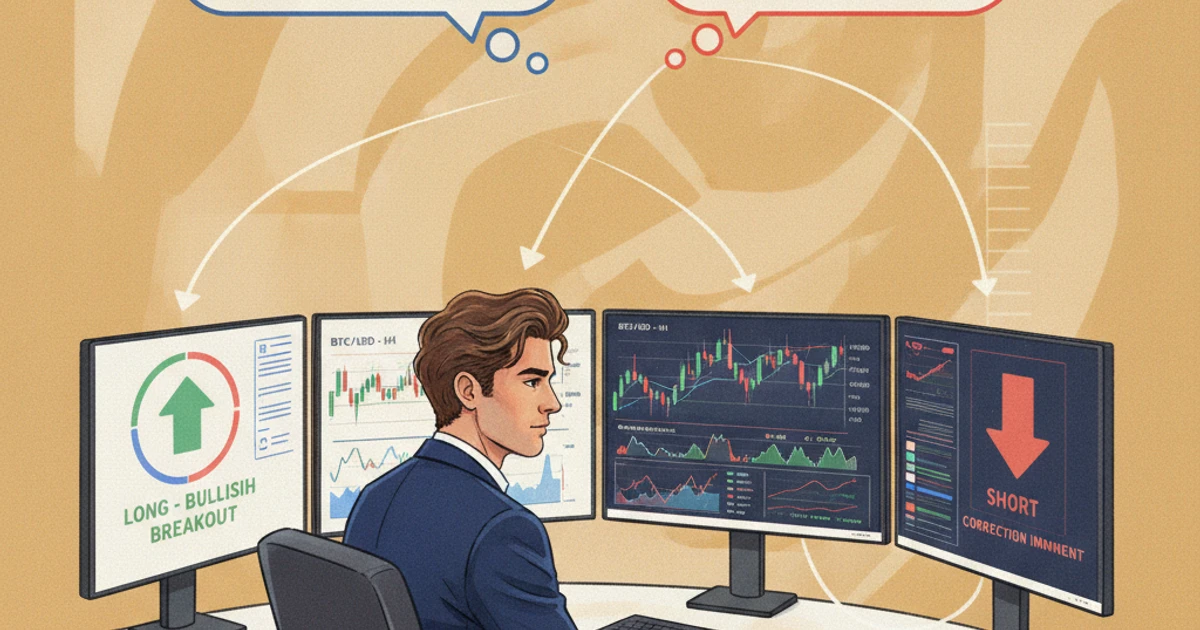
This guide provides a complete walkthrough of multi-timeframe momentum analysis, a trading method for analyzing a stock across three distinct time horizons to make higher-probability decisions. Think of the market like the ocean: the higher timeframe is the bigger wave, the slow-moving force that sets the overall direction of the water. The middle timeframe is a smaller wave riding on top of it, rising and breaking within that bigger movement to form a tradeable setup. The lower timeframe is the surface ripple, where you time your actual entry. A surfer who paddles against the bigger wave gets pushed back no matter how well they catch a smaller one, and a trader who takes a lower-timeframe entry against the higher-timeframe trend faces the same uphill battle. The core principle is simple: use the higher timeframe for trend, the middle timeframe for a setup, and the lower timeframe for entry. By layering momentum signals like the Relative Strength Index (RSI), the direction it's moving in, and a stock's EMAs, you can confirm that price movements have genuine strength rather than just surface noise. This means checking where the price sits relative to its EMAs, whether those EMAs are sloping up or down, and whether any EMA crossovers are confirming the move. When these three layers of time and momentum align, you're trading with the market's underlying current, not paddling against it. This guide covers everything from selecting your timeframes to managing risk, enabling you to apply this powerful technique to any S&P 500, NSE, or TSX stock.
Define Momentum and Timeframes: Understand what momentum is, how technical indicators like RSI and EMAs measure it, and why its behavior changes across different timeframes.
Build a Top-Down Routine: Learn to construct a structured analysis process using three coordinated timeframes (Monthly, Weekly, and Daily) to establish a clear directional bias.
Filter for High-Probability Setups: Apply RSI and Exponential Moving Average (EMA) filters, including EMA placement, crossovers, and slope- to isolate trade setups that have confirmed momentum and are aligned with the primary trend.
Avoid Common Trading Errors: Learn to recognize and prevent the most common mistakes — such as analysis paralysis, entering counter-trend trades, and stacking redundant indicators — that undermine retail trader performance.
Prerequisites: Basic familiarity with candlestick charts and an understanding of what a moving average represents. No advanced coding or mathematical skills are required.
Why Multi-Timeframe Momentum Analysis Matters in 2026
Most retail traders lose money for a reason that has little to do with intelligence or effort: they read one chart, in one timeframe, and make decisions based on incomplete context. The majority of trading mistakes do not stem from poor entries but from a fundamental lack of market context. Traders often fixate on a single chart, such as the Daily, and completely miss the dominant trend unfolding on the Monthly. A bullish RSI signal on a Daily chart is effectively meaningless if the Monthly chart is in a confirmed, structural downtrend. This isn't bad luck; it is an incomplete analysis, and it is entirely preventable.
This is largely a function of analysis order. Traders who start on a lower timeframe and spot a signal there often either forget to check the higher timeframe altogether, or unconsciously bend their higher-timeframe read to justify the trade they already want to take. A top-down approach — starting on the Monthly to establish the broader trend, narrowing to the Weekly to refine it, and using the Daily to confirm momentum and timing — removes that bias by design. You form your view of the trend before you go looking for a reason to act on it, not after.
In 2026, with algorithmic trading dominating intraday price action and volatility spiking around macroeconomic events, the need for structural context is greater than ever before. Many technical indicators and chart patterns fail when they are interpreted out of context. As a core principle, higher timeframes help filter out the low-quality, noisy signals generated on lower timeframes. Traders who incorporate timeframe alignment into their process don't just trade more accurately — they trade less frequently, with greater conviction, and with better-defined risk on every single position.
Key Takeaway: Adopting a multi-timeframe approach is one of the most effective ways to add market context to your trading, helping you filter out noise and align your trades with the dominant, underlying trend rather than reacting to a single chart in isolation. For supporting data, see How To Perform A Multi TimeFrame Analysis + 5 Strategies.
The Process at a Glance
Step | Action | Time | Outcome |
|---|---|---|---|
1 | Understand momentum and why it matters | 1–2 days | Clear definition of momentum indicators |
2 | Choose your three-timeframe stack | 1 day | Consistent timeframe framework selected |
3 | Analyze the higher timeframe for trend | Daily, 10 min | Primary trend direction identified |
4 | Confirm momentum on the middle timeframe | Daily, 10 min | Setup quality scored, weak setups filtered |
5 | Time your entry on the lower timeframe | Daily, 5–10 min | Precise, low-risk entry point identified |
6 | Apply risk management with timeframe logic | Per trade, 5 min | Stop and target set using structural levels |
7 | Review and refine your alignment process | Weekly, 20 min | Win rate data tracked by alignment score |
Total time to basic proficiency: 3–6 weeks of focused daily practice applying the process to real charts before committing live capital.
Step 1: Understand What Momentum Is and How It Is Measured
What You're Doing
Before you can apply multi-timeframe momentum analysis, you must establish a precise, working definition of momentum—not just an intuitive sense that a stock is "moving fast," but a measurable, indicator-based understanding of whether price movement has sustained conviction behind it.
How to Do It
Define momentum technically. In financial technical analysis, momentum is a measure of the speed or velocity of price changes, often calculated as the difference between today's closing price and the close N days ago. Momentum oscillators like the RSI help identify whether a trend is accelerating or decelerating by tracking the speed and change of recent price movements. It answers a simple question: is the current move gaining strength or losing it?
Learn the core indicator set. While many technical indicators can be adapted across different intervals, beginners should focus on a complementary, non-redundant set. An Exponential Moving Average (EMA) is a type of moving average that gives more weight to recent prices, making it effective for identifying both the current trend and its strength. For this process, we will rely on two complementary tools: the Relative Strength Index (RSI) for momentum and overbought/oversold conditions, and a set of EMAs for trend direction, placement, and crossovers. This restraint is intentional—you'll see why as we go.
Understand RSI defaults and EMA signals. For the RSI, a standard 14-period setting is effective for filtering trades. Bullish conditions are often indicated by an RSI between 45–70, showing upward momentum without being excessively overbought. Bearish conditions are suggested by an RSI between 30–55, showing downward momentum without being excessively oversold. For EMAs, three signals matter most: placement (is price trading above or below the EMA), slope (is the EMA itself rising or falling), and crossovers (is a shorter EMA crossing above or below a longer one, such as the 20 crossing above the 50). Together, these tell you not just where price is, but whether the trend underneath it is strengthening or weakening.
Recognize that momentum behaves differently by timeframe. The core of this methodology is understanding that each timeframe provides different information about trend, momentum, and noise. A Monthly RSI reading of 65 tells a very different story than a Daily RSI at 65. The former reflects sustained strength built up over months of price action, while the latter may simply reflect a short-lived burst of buying that has not yet been confirmed at a higher level.
Best Practices
Do not use multiple momentum oscillators (e.g., RSI, Stochastics, and Williams %R) simultaneously on the same chart. Overloading charts with redundant indicators creates confusion and analysis paralysis. Stick to a complementary toolkit: EMAs for trend context (placement, slope, and crossovers), and RSI for momentum strength and overbought/oversold conditions.
Always view momentum in the context of price structure, not in isolation. An RSI reading only becomes actionable when it is paired with a key support or resistance level on the chart, confirming that a reaction is occurring at a structurally significant price.
Key Takeaway: Master the standard RSI (14) setting and learn to read EMA placement, slope, and crossovers together to get a clear, quantifiable measure of momentum, and always remember that the significance of an indicator's reading is directly tied to the timeframe you are viewing.
What Done Looks Like
You can open any stock chart, add RSI (14) and a set of key EMAs, and verbally explain what each one's current reading means for the direction and strength of the price move without needing to look up a definition. For a deeper dive into the RSI itself, see What is RSI? — Relative Strength Index | Fidelity
Step 2: Choose Your Three-Timeframe Stack
What You're Doing
You are selecting three timeframes—one higher, one middle, and one lower—that work together logically based on your intended holding period. The relationship between these timeframes is not arbitrary; spacing them correctly is what creates meaningful context rather than contradictory noise.
How to Do It
Match your stack to your holding period. In practice, the higher timeframe answers "what" to trade (the direction), while the lower timeframe answers "when" to trade (the entry). For stock-level momentum analysis, the natural stack is the Monthly chart for trend, the Weekly chart for setup, and the Daily chart for entry. This combination works whether you're holding a position for a couple of weeks or several months—what changes is how strictly you wait for full alignment, not the timeframes themselves.
Keep spacing consistent. To maintain analytical clarity and get sufficient market context, traders generally aim for a meaningful gap between timeframes rather than charts that are too close together and simply echo the same noise. The Monthly-to-Weekly-to-Daily stack naturally satisfies this: there are roughly four to five Weekly candles in a Month, and roughly five Daily candles in a Week, so each timeframe genuinely adds a distinct layer of information instead of repeating the one above it.
Adjust how strictly you require alignment, not the timeframes themselves. A position trader holding for months will typically wait for full alignment across all three timeframes before entering, accepting fewer trades in exchange for higher conviction. A more active swing trader working the same Monthly/Weekly/Daily stack might act on strong Weekly and Daily alignment alone, using a smaller position size when the Monthly trend is still neutral rather than fully confirmed.
Commit to your stack and do not change it mid-analysis. Switching timeframes after a signal appears in an attempt to find confirmation is a form of confirmation bias that will consistently mislead you and undermine your process. Pick your three, and live with them for at least four weeks before reconsidering.
Example: Timeframe Stacks by Trading Style
Trading Style | Higher TF (Trend) | Middle TF (Setup) | Lower TF (Entry) | Typical Hold Time |
|---|---|---|---|---|
Active Swing Trader | Monthly | Weekly | Daily | Days to 2 weeks |
Swing Trader | Monthly | Weekly | Daily | 2–6 weeks |
Position Trader | Monthly | Weekly | Daily | Months to a year+ |
What Done Looks Like
You have three timeframe windows open on your charting platform, each assigned a specific role—trend context, setup qualification, or entry timing—and you do not deviate from this structure when analyzing any stock.
Step 3: Analyze the Higher Timeframe for Trend Direction
What You're Doing
You are establishing the primary trend bias that will govern every trade decision made on the lower timeframes. This is the most important step in the entire process; getting the higher-timeframe direction wrong makes all subsequent analysis irrelevant. Think of this as setting your compass before you navigate—without it, every other move is a guess.
How to Do It
Open your higher timeframe chart (the Monthly, per our three-timeframe stack). Add a 200-period Exponential Moving Average (EMA) along with a couple of shorter EMAs you'll use for crossover signals later, such as the 20 and 50.
Determine trend direction. This process combines trend-following via the 200 EMA with the placement and slope of your shorter EMAs. If price is trading above the 200 EMA, and the 20 EMA is above the 50 EMA with both sloping upward, the primary trend is bullish. If price is below the 200 EMA and the shorter EMAs are below it and sloping downward, the trend is bearish. A recent crossover—say, the 20 EMA crossing above the 50—adds further confirmation that the trend is freshly strengthening rather than aging.
Identify key structural levels. Mark the most recent significant swing high and swing low on this higher timeframe. These price zones become the critical areas where momentum reactions are most likely to be meaningful on the lower timeframes.
Assign a trend bias: Bullish, Bearish, or Neutral. You should only proceed to the middle timeframe if a clear directional bias exists. A neutral or sideways higher timeframe is a signal to stand aside and wait, not a prompt to search harder for a trade. This restraint is where many traders struggle—they want to trade, so they convince themselves that ambiguous setups are tradable. They rarely are.
Apply this rule absolutely. A foundational rule of technical analysis is to always start your analysis from the highest timeframe and work your way down. Never trade against the higher timeframe trend without exceptionally compelling, data-driven reasons.
Common Mistakes
Skipping the higher timeframe when in a hurry. Many traders become so focused on lower-timeframe entries that they ignore the bigger picture. Without checking the higher timeframes, you might enter a long position on the Daily chart, only to discover that the Monthly chart shows a strong downtrend and your "breakout" is occurring directly at a major resistance level.
Treating pullbacks as reversals. A stock can be in a powerful, long-term uptrend while experiencing a multi-week pullback in the short term. Looking at only one timeframe can completely distort this picture, causing you to mistake a healthy consolidation for a bearish reversal.
Key Takeaway: The higher timeframe is your strategic map. Before you even consider a trade, you must use it to define your bias (bullish, bearish, or neutral) and identify the key price levels that matter most.
What Done Looks Like
You have written down a one-sentence bias statement—for example, "Monthly trend is bullish: price is above the 200 EMA, the 20 EMA is above the 50 EMA with both sloping up, and the most recent swing low is at $142.30"—before you even open the middle timeframe chart.
Step 4: Confirm Momentum on the Middle Timeframe
What You're Doing
On the middle timeframe (the Weekly, per our stack), you qualify potential trade setups by confirming that momentum aligns with the higher-timeframe trend. You are looking for a specific pattern or indicator configuration that supports your directional bias, and you are checking that the momentum behind the move is genuine and not exhausted. This is where you separate high-probability setups from the tempting-but-doomed ones.
How to Do It
Apply RSI (14) to the Weekly chart. In a bullish trend context established on the Monthly, you should look for the RSI to be rising from below 50 or recovering from a pullback into the 40–55 zone. This "reset" signals that momentum is reloading for the next move up, rather than reversing.
Apply EMA crossover signals to the Weekly chart. The EMA crossover here acts as your primary "trend filter" for the setup itself, determining whether you should be actively looking for buy opportunities, sell opportunities, or staying out of the market entirely. In an uptrend, a shorter EMA (e.g., the 20) crossing back above a longer EMA (e.g., the 50)—or price reclaiming and holding above the 50 EMA after a pullback—is a strong confirmation signal.
Score the alignment. Assign a simple score to the setup: does the EMA crossover or placement confirm the higher-timeframe bias? Does the RSI confirm it? A 2-out-of-2 score means you can proceed to the entry timeframe with high confidence. A 1-out-of-2 score suggests you should reduce your position size or wait for stronger confirmation.
Look for a setup pattern. Common patterns to look for on this timeframe include pullbacks to a rising moving average (like the 50 EMA), bull flag consolidations, and bullish momentum divergences (where price makes a new low but the RSI makes a higher low, signaling downside exhaustion).
Example: Middle Timeframe Confirmation Checklist
Check | Bullish Signal | Bearish Signal | Neutral / Skip |
|---|---|---|---|
EMA crossover & slope | Short EMA above long EMA, both sloping up | Short EMA below long EMA, both sloping down | EMAs flat or repeatedly crossing |
RSI (14) | 45–65, rising from pullback | 35–55, falling from bounce | Below 45 in uptrend |
Change in RSI | Rising week-over-week | Falling week-over-week | Flat / sideways |
Price vs. 50 EMA | Above and holding on pullback | Below and failing on rally | Whipsawing around it |
Best Practices
When multiple timeframes align to support a trade setup, the probability of success increases. This confluence-based approach naturally reduces the number of trades you take, but it improves their quality. Fewer trades with higher conviction is generally preferable to frequent, uncertain entries.
Do not look for perfect alignment across every single indicator. Instead, look for dominant alignment. If two of your three primary signals (Price vs. EMA, EMA crossover, RSI) confirm the trend, that is often a tradable signal.
What Done Looks Like
You have an alignment score of at least 2/2 or 3/3 on your Weekly timeframe, confirmed by at least two complementary signals, and the setup pattern is clear and fully consistent with your Monthly bias.
Step 5: Time Your Entry on the Lower Timeframe
What You're Doing
On the lower timeframe (the Daily, per our stack), you identify the precise, lowest-risk moment to enter a trade that has already been qualified on the higher and middle timeframes. You are not making new trend decisions here; you are simply using this timeframe as a precision instrument for execution. This is where patience pays off in the form of better entry prices and tighter stops.
How to Do It
Open the Daily chart. Do not add new indicators; use the same RSI and EMAs that are already part of your established process.
Wait for a momentum trigger in the direction of your bias. A practical trigger for a long trade is to enter when a short EMA crosses above a slightly longer EMA on the Daily chart (e.g., the 9 EMA crossing above the 20 EMA) while the Daily RSI is rising through 50, confirming that short-term momentum is turning in the direction of the established trend.
Do not chase breakouts. While higher timeframes provide direction, the Daily chart excels at execution. This allows you to enter trades at optimal prices during minor pullbacks, rather than chasing momentum after the most significant part of the move has already occurred.
Define your entry price, stop level, and first target before executing the trade. Entry discipline is impossible if these three critical numbers are not written down in your trading log before you place the order.
Use momentum platforms to surface pre-screened candidates. Services like AltraOne provide MTF scores—a composite of EMA and RSI signals across Daily, Weekly, and Monthly timeframes—for stocks across the S&P 500, NSE, and TSX. This allows you to begin Step 5 with a shortlist of stocks that have already passed the higher and middle timeframe tests, saving you valuable screening time.
Example: Swing Trade Entry Scenario
Stock: A large-cap S&P 500 technology name
Monthly chart: Price is above the 200 EMA, and the 20 EMA is above the 50 EMA with both sloping up. Bullish bias confirmed.
Weekly chart: Price pulls back to the rising 50 EMA. The RSI resets to 48 and begins rising. The 20 EMA crosses back above the 50 EMA. Setup qualified.
Daily chart: The 9 EMA crosses above the 20 EMA. The RSI is rising through 51. Entry triggered at the next Daily open. The stop is placed below the Weekly 50 EMA.
Result: Three timeframes are aligned. The entry is taken with full position size.
Common Mistakes
Using the lower timeframe to override the higher-timeframe decision. If the higher and middle timeframes are both bullish but the lower timeframe shows temporary weakness, do not exit or avoid the entry. The lower timeframe is the noisiest and generates the most false signals. Using it to override the alignment of higher timeframes will cause you to miss excellent trades. The lower timeframe should only refine your entry timing, not determine the trade's direction.
Key Takeaway: The lower timeframe is for execution, not analysis. Wait patiently for a pre-defined momentum trigger that aligns with your higher-level bias to get a low-risk entry point.
What Done Looks Like
You have placed or planned a trade with a specific entry price, a stop loss set just below the nearest structural level on the Daily chart, and a first profit target defined at the next significant resistance level on the Weekly chart—all documented in your trade log before execution.
Step 6: Apply Risk Management Using Timeframe Logic
What You're Doing
In this step, you apply a structured risk management framework using the logic of your timeframe stack to define stop losses, position sizes, and profit targets. Multi-timeframe momentum analysis improves not just your win rate but also your risk-to-reward ratio by providing clear, structurally significant levels for placing stops and targets. This is where the method translates into real money management.
How to Do It
Place your stop loss below the Daily structural level that, if broken, would invalidate the entire setup. This is typically the swing low that formed immediately before your entry trigger.
Size your position using a fixed percentage of your account equity. A standard best practice is to risk only 1–2% of your total account equity per trade, calculated based on the distance from your entry price to your stop-loss level. This ensures that no single trade can be catastrophic to your account, regardless of the outcome.
Set your first target at the next significant level on the middle timeframe. Because you are entering at a key zone that aligns with the broader trend, your stop loss can be placed tightly beyond the structural level that invalidates the trade. Your target can then be set at the next significant resistance level on the Weekly or Monthly chart, which often results in a potential reward that is several times your initial risk.
Reduce size when alignment is partial. As a rule, when the alignment score drops to 2/3, you should either skip the trade entirely or reduce your standard position size to account for the lower probability. Full size should be reserved for full 3/3 alignment.
Monitor for momentum deterioration after entry. Multi-timeframe analysis is also crucial for in-trade risk management. If momentum begins to weaken or signals start to conflict across timeframes—for example, if the Daily chart shows a bearish RSI divergence against the higher-timeframe uptrend—it may be prudent to tighten your stop, take partial profits, or exit the trade entirely.
Best Practices
Never widen your stop after entering a trade. If the price reaches your pre-defined stop level, the setup has been invalidated by the market. Exit the position and reassess the situation from the higher timeframe.
Avoid taking multiple positions in highly correlated instruments at the same time. For example, going long on an individual technology stock and long on a broad technology sector ETF simultaneously exposes you to the same risk, as a single higher-timeframe reversal will likely hit both of your stops.
Key Takeaway: Use your timeframe stack to manage risk. Place stops based on Daily structure, set targets based on Weekly structure, and adjust your position size based on the degree of alignment across all three timeframes.
What Done Looks Like
Every open trade in your portfolio has a documented entry price, stop level, target level, and a position size that was calculated to risk exactly 1–2% of your account, with no exceptions made for setups that "feel" stronger than others.
Step 7: Review Your Process Weekly and Track Alignment Data
What You're Doing
This final step involves creating a crucial feedback loop by systematically reviewing your trades, tracking your performance against your alignment score, and using that data to refine your process. This is what separates traders who improve from those who repeat the same mistakes indefinitely. Most traders skip this step entirely, which is why they stop improving after their first few weeks.
How to Do It
Log every trade with its alignment details. For each trade, you must document every step of your analysis: the Monthly bias, the Weekly setup, the Daily entry trigger, your stop, and your targets. Crucially, record whether all three timeframes were confirmed at the time of entry.
Track your win rate by alignment score. Your own data will become your best teacher. Track your win rate segmented by the alignment score (1/3, 2/3, or 3/3). Most traders find that fully aligned setups outperform partially aligned ones over a large enough sample, but the exact gap varies by trader, market, and time period—your own log is the only reliable source for your numbers. This data provides the objective proof needed to justify waiting patiently for the best setups.
Ask specific improvement questions each week. During your weekly review, ask targeted questions about your execution: How many of my trades had full three-timeframe alignment? What was the win rate on those aligned trades versus the misaligned ones? Did I ever enter a trade without first checking the higher timeframe?
Use a charting platform with multi-timeframe capabilities for your review. TradingView allows you to save chart layouts to review historical price action across all three of your timeframes simultaneously. TrendSpider can automate multi-timeframe scanning to surface the precise conditions you have defined, making your weekly review faster and more objective. AltraOne publishes MTF scores—combining EMA and RSI signals across Daily, Weekly, and Monthly timeframes—for stocks across the S&P 500, NSE, and TSX, giving you a consistent external benchmark to compare against your own analysis each week.
What Done Looks Like
After four weeks of consistent logging, you have a spreadsheet or journal showing your personal win rate at each alignment score level (1/3, 2/3, 3/3), you have identified at least one specific process adjustment from the data, and you have a clear sense of which timeframe combination works best for your trading style.
What to Do After Completing the Process
Phase 1: Solidify the Habit (Weeks 1–3)
During the first three weeks, practice the full top-down process on five to ten stocks per day using paper trades or a simulator. Do not focus on the financial outcomes; focus exclusively on process consistency. Document every single analysis in a structured log. The goal at this stage is to make the three-timeframe review process completely automatic before any real capital is at risk.
Phase 2: Optimize Your Stack (Weeks 4–8)
Review your alignment data from Phase 1 and identify your edge. Are your 3/3 alignment trades performing noticeably better than your 2/3 trades? If so, make a rule to increase your patience and wait only for full alignment. Begin using screeners and momentum scoring tools—including AltraOne's free MTF scores—to surface candidates that are already showing multi-timeframe strength, so your analysis time is focused on the most promising setups rather than scanning from scratch.
Phase 3: Scale and Specialize (Months 2–4)
Once your process is proven with positive expectancy across at least 50 logged trades, you can gradually introduce live capital at conservative position sizes (e.g., risking 0.5% of equity per trade). Specialize in one market first—such as S&P 500 large-caps, TSX growth stocks, or NSE momentum names—before expanding. At this stage, you can layer in sector rotation awareness: when an entire sector shows multi-timeframe momentum alignment, individual stock setups within that sector carry a higher probability of follow-through.
Resources You'll Need
Resource | Role in the Process | Required / Recommended / Optional | Price |
|---|---|---|---|
MTF scores combining EMA and RSI signals across Daily, Weekly, and Monthly timeframes for ~1,000 stocks across the S&P 500, NSE, and TSX — surfaces high-probability setups without requiring signup | Recommended | Free | |
TradingView | Charting platform for multi-timeframe chart layout, RSI and EMA application, and trade logging | Required | Free tier available; Pro from $14.95/month |
TrendSpider | Automated multi-timeframe scanning, pattern recognition, and strategy backtesting across timeframes simultaneously | Recommended | From $39/month |
Quantified Strategies — Multi-Timeframe Analysis Guide | Backtested research and methodology reference for building rules-based multi-timeframe strategies | Recommended | Free |
Finviz Stock Screener | Initial stock screening to build a watchlist of momentum candidates before applying multi-timeframe analysis | Optional | Free; Elite from $39.50/month |
See also Multi-Time Frame Trading Analysis: A Guide for Traders.
Troubleshooting Common Issues
Problem: Your signals conflict between timeframes and you cannot decide what to do
Likely cause: Using too many timeframes or indicators can lead to a state of indecision known as "analysis paralysis." Conflicting signals are a common occurrence, such as seeing bullish momentum on the Weekly chart while the Daily chart shows a bearish divergence.
Fix: Apply the hierarchy rule without exception: the higher timeframe always wins. If your charts disagree, you must either follow the bigger picture or stay out of the market entirely. If your higher and middle timeframes agree but your lower timeframe does not, the correct action is to wait for the lower timeframe to align rather than forcing an entry. If your higher and middle timeframes disagree, the trade simply does not exist—move on to the next candidate.
Problem: You are taking too many trades and your win rate is disappointing
Likely cause: You are entering on 2/3 or even 1/3 alignment instead of waiting patiently for full confirmation.
Fix: Return to your trade log and calculate your win rate separately for each alignment score. In most traders' logs, fully aligned (3/3) setups meaningfully outperform partially aligned ones—seeing that gap in your own data is what makes the discipline to wait worth it. Impose a strict rule: no trade is entered unless alignment is at least 2/3, and full position size is only used at 3/3.
Problem: Your higher timeframe identifies a bullish trend but you keep losing on long trades
Likely cause: You are entering during a phase of momentum exhaustion rather than momentum resumption. A bullish higher timeframe does not mean momentum is continuously strong; it simply means the overall trend bias is up. Within that trend, there will be natural phases of exhaustion where the RSI becomes overbought and price stretches well above its shorter EMAs before pulling back.
Fix: Look for reset entries on the middle timeframe. Wait for the RSI to pull back into the 45–55 support zone and for price to hold above (or reclaim) its key EMA before considering an entry. Always check EMA placement and slope on the higher timeframe first to determine your trend filter—this tells you whether you should even be looking for buy opportunities in the first place.
Problem: You analyze well but consistently miss entries because you hesitate
Likely cause: Your lower timeframe trigger criteria are too vague, which leaves room for doubt and indecision at the critical moment of execution.
Fix: Write a precise, binary, and non-negotiable rule for your entry trigger. For example: "Enter on the Daily open ONLY IF the 9 EMA has crossed above the 20 EMA AND the RSI is above 50 AND price is above the 50 EMA." Pre-define this checklist and use it as a simple go/no-go decision tool rather than a starting point for further deliberation. As a best practice, you should journal every trade, noting which timeframe gave the signal and whether the charts were truly aligned.
Key Takeaway: Most multi-timeframe trading problems are not analytical but psychological. The solution is often to simplify your rules, trust the higher timeframe's direction, and use a detailed trade log to hold yourself accountable to your process. For more on the top-down discipline, see Multiple Time Frame Analysis Definition | Forexpedia by BabyPips.com
Conclusion
Key Takeaways
Outcome recap: Multi-timeframe momentum analysis provides a structured, repeatable process for identifying trades where trend, setup, and timing are all confirmed. This alignment is what separates traders who consistently catch the dominant move from those who keep fighting it, without requiring any better prediction of where the market goes next.
Key insight: The most important discipline in multi-timeframe momentum analysis, explained properly, is the unwavering adherence to the top-down hierarchy rule. As a core principle, higher timeframes filter out the low-quality signals from lower timeframes. When multiple timeframes align, trades feel less random, which increases conviction without increasing risk.
Next action: Open your charting platform today and set up a Monthly/Weekly/Daily layout. Then, visit AltraOne to explore MTF scores across the S&P 500, NSE, and TSX. This gives you a starting watchlist of candidates that already show multi-timeframe momentum strength, so you can begin your analysis with high-potential names rather than scanning from zero.
FAQ
What is multi-timeframe momentum analysis explained simply?
Multi-timeframe momentum analysis explained at its core is a method for analyzing a stock across three coordinated timeframes to ensure you are trading with the dominant market trend. The process involves using a higher timeframe (e.g., Monthly) to establish the primary trend, a middle timeframe (e.g., Weekly) to identify a setup, and a lower timeframe (e.g., Daily) to pinpoint a low-risk entry. Momentum signals like RSI and EMA placement, slope, and crossovers are used on each timeframe to confirm that price moves have real strength. When all three timeframes align, the probability of a successful trade increases. This technique is used by traders in markets like the S&P 500, NSE, and TSX to filter out market noise and improve their decision-making.
How many timeframes should a beginner use?
A beginner should start with just two or three timeframes to keep the analysis simple and focused. The most critical skill to develop first is aligning your trades with the higher timeframe trend. A two-timeframe framework—one for trend and one for entry—is a perfectly functional starting point. Adding a third, middle timeframe for setup refinement is a natural next step once the two-timeframe habit is established. Using more than three timeframes too early is a common mistake that almost always leads to analysis paralysis and worse decision-making.
What is the best combination of indicators for multi-timeframe momentum analysis?
The best combination uses complementary, not redundant, signals. A widely accepted principle is that the selected indicators should each focus on a different aspect of the market to form a comprehensive view. For beginners, the most practical combination is: a 200-period EMA on the higher timeframe for trend direction, EMA crossovers (such as the 20 and 50) on the middle timeframe for momentum confirmation, and RSI (14) on the lower timeframe for entry timing. Together, these cover trend, momentum, and overbought/oversold conditions without creating analytical overload.
What timeframe stack works best for swing trading stocks?
The most widely used stack for swing trading S&P 500, NSE, or TSX stocks is Monthly (for trend), Weekly (for setup), and Daily (for entry). The Monthly chart establishes whether the stock is in a sustained uptrend or downtrend. The Weekly chart identifies when momentum is resetting during a tradeable pullback. The Daily chart then provides the precise entry trigger once the Weekly setup is confirmed. This stack typically results in holding times of a couple of weeks to a couple of months, which suits most retail swing trading schedules.
How does multi-timeframe analysis improve win rates?
Multi-timeframe analysis improves win rates by systematically filtering out low-probability trades. A setup that looks promising on a single timeframe might be directly opposed to the dominant trend on a higher timeframe. By requiring confirmation across multiple timeframes, you eliminate these structurally flawed trades before you ever risk capital on them. The improvement comes from avoiding the "good-looking" trades that are likely to fail because they violate the market's broader structure, not from any single indicator having predictive power on its own.
What tools help automate multi-timeframe momentum screening?
Several platforms can help automate multi-timeframe momentum screening. AltraOne delivers free MTF scores—combining EMA and RSI signals across Daily, Weekly, and Monthly timeframes—for stocks across the S&P 500, NSE, and TSX, making it an excellent starting point for building a watchlist. TrendSpider offers advanced, automated multi-timeframe scanning where you can filter for setups that meet your specific criteria across short, intermediate, and long-term views simultaneously. TradingView provides a powerful free charting environment and a stock screener that, when combined with custom alerts, can notify you when specific multi-timeframe conditions are met.
What is the most common mistake in multi-timeframe momentum analysis?
The most common and costly mistake is using the lower timeframe to override or contradict the higher timeframe's bias. For example, taking countertrend trades on the Daily chart while the Monthly chart is trending strongly against you is a recipe for destroying an account. The solution is to always trade in the direction of the higher timeframe trend. A close second is analyzing too many timeframes at once, which leads to analysis paralysis from conflicting signals, causing you to miss the setup entirely. Limit your framework to three timeframes maximum and apply the hierarchy rule without exception.
How long does it take to become proficient at multi-timeframe momentum analysis?
Most traders who follow a structured daily practice—reviewing three to five setups per day, logging every trade with alignment data, and conducting a weekly process review—can develop meaningful proficiency within three to six weeks. The mechanical process of reading three charts and checking RSI and EMAs can be learned in a few days. The more difficult skill is developing the psychological discipline to stay out of trades that do not fully align, which typically requires four to eight weeks of real or simulated practice to internalize. Building a personal data set of at least fifty logged trades is the most reliable way to validate that your process is working and to gain true confidence in your execution.
Methodology note: This guide reflects a synthesis of publicly available research on multi-timeframe trading methodologies and practitioner best practices as of June 2026, adapted to a Daily/Weekly/Monthly, EMA-and-RSI-based framework. All trading involves risk, and past performance of any strategy or methodology does not guarantee future results. Nothing in this article constitutes financial advice or a recommendation to buy or sell any security. Always conduct your own analysis and consult a qualified financial professional before making investment decisions.